Quick answer
Exporting a group's member list isn't automatically illegal. For personal use it's usually fine. For business use, laws like GDPR, Brazil's LGPD and India's DPDP Act need a legal reason, often consent, to store and use the numbers, and WhatsApp requires opt-in before businesses message anyone. This is not legal advice.
You exported a WhatsApp group, and now you have a spreadsheet with 300 phone numbers. The next question is the right one: is it legal to export WhatsApp group contacts, and what can you do with the list?
The short version: exporting is rarely the problem. Using the list for sales messages without permission is. This article explains why, in plain words.
Seeing a number isn't permission to message it
When you join a group, you can see the other members' numbers. They shared them with the group, for the group's purpose: a school class, a trade fair, a supplier network. They didn't agree to join your sales list.
Most privacy laws follow the same idea. People give their data for one purpose, and using it for another needs a good reason. Keeping a list for your own reference is one thing. Messaging everyone on it with an offer is another, and that's where most of the trouble starts.
Consent and opt-in in plain words
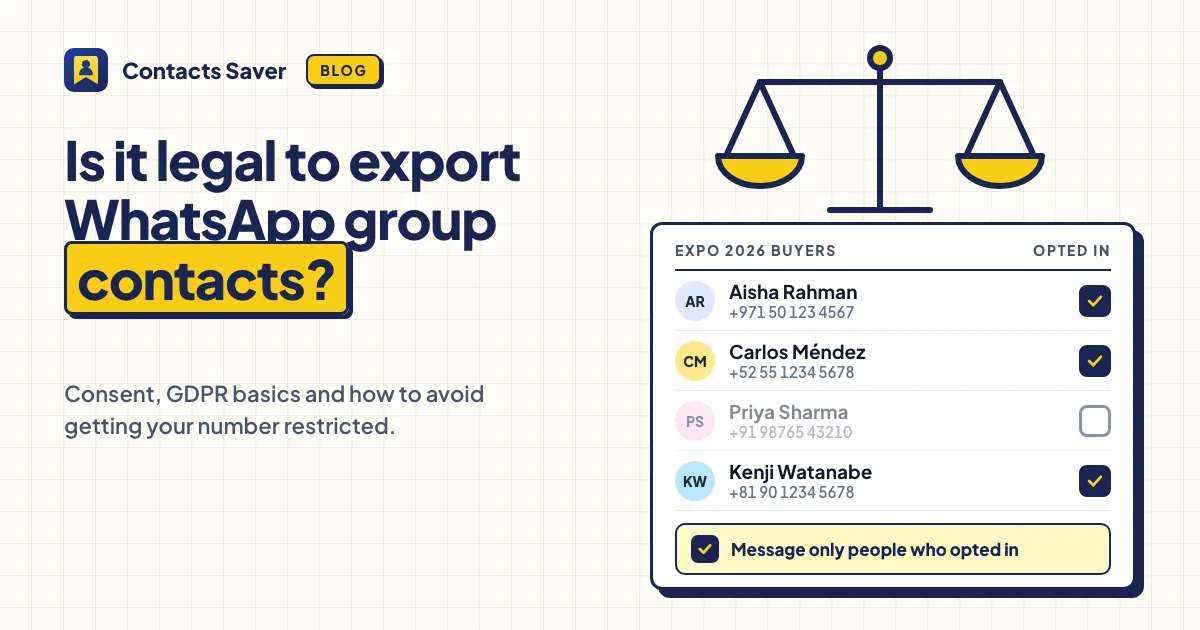
Consent means the person clearly said yes to hearing from you, about this kind of message, on this channel. Silence isn't consent, and being in the same group isn't either.
Opt-in is how you collect that yes. For example, if the group rules allow it, post: "Reply YES if you'd like our price list on WhatsApp." Only the people who reply YES go on your list. A sign-up form at your trade-show booth or on your website works too.
Keep a record of who agreed, when and how. If someone asks, you can show it.
GDPR, LGPD and India's DPDP Act: a short primer
GDPR (European Union)
The General Data Protection Regulation protects people in the EU, and it can apply to a business outside Europe that offers goods or services to them. A phone number linked to a person is personal data. Storing or using it for business needs a lawful basis under Article 6, such as consent, and people can object to direct marketing at any time. Purely personal or household use falls outside the GDPR. Fines can reach €20 million or 4% of worldwide annual turnover, whichever is higher.
LGPD (Brazil)
Brazil's Lei Geral de Proteção de Dados (Law No. 13.709/2018) works much like GDPR. It covers personal data of people in Brazil and needs a legal basis, such as consent or legitimate interest. People can ask to see or delete their data, and the national authority, ANPD, enforces the law. Use by an individual for strictly private, non-commercial purposes is excluded.
DPDP Act 2023 (India)
India's Digital Personal Data Protection Act, 2023 covers digital personal data, which includes phone numbers in a spreadsheet. A business generally needs the person's consent: given freely, for a specific purpose, after a clear notice. People can withdraw consent as easily as they gave it. The Act doesn't apply to data used for purely personal or domestic purposes. It's enforced by the Data Protection Board of India, and its rules are being phased in.
Many other countries have similar laws, and many also have separate rules for marketing messages. The pattern is the same everywhere: business messages need a legal reason, usually consent.
What WhatsApp's own rules say
WhatsApp's Business Messaging Policy is direct. A business may only contact people on WhatsApp if they gave the business their number and opted in to receive its messages. The business must also respect every request to stop, on or off WhatsApp.
A number you copied from a group doesn't meet the first condition. The person gave it to the group, not to you.
WhatsApp also bans accounts for spam and for automated or bulk messaging. It uses automated signals and reports from users, so if many people block or report your number, your account can be restricted or banned. See About account bans and unauthorized automated or bulk messaging in WhatsApp's Help Center.
Contacts Saver only reads and exports. It sends no messages. Still, no tool can promise how WhatsApp treats an account. That depends on how you use the list.
Will group members know I exported their numbers?
No. Exporting sends no message and no notification to anyone in the group. Contacts Saver reads the member list through WhatsApp Web, the same list you see in the group info.
But nobody being notified doesn't make every use okay. The rules above apply as soon as you store or use the list for business.
Practical rules for using an exported list
- Announce it. Tell the group what you want to collect numbers for, and invite people to opt in.
- Message only people who said yes. Keep a record of when and how they agreed. Don't add anyone to a new group without asking first.
- Make opting out easy. Add a line like "Reply STOP to stop these messages", and remove people the same day they ask.
- Don't sell or share the list. The people on it never agreed to hear from someone else.
- Keep the file secure. It's saved on your computer, so store it safely, don't email it around, and limit who can open it.
- Delete it when you're done. A list you no longer need is only a risk.
These rules also protect your WhatsApp number. People who expect your message rarely report it.
So, is it legal to export WhatsApp group contacts?
In most cases, exporting the list isn't what gets people into trouble. Messaging it without permission is. Keep personal lists personal, ask before you market, and follow the rules above. Used with care, an exported list is a normal business tool: a CRM import, a backup of your customers or a list of people who asked to hear from you. For the export itself, see How to Export WhatsApp Group Contacts to Excel. Contacts Saver is an independent product and is not affiliated with WhatsApp or Meta Platforms, Inc.
Export with care
Contacts Saver keeps contact data in your browser and saves the file straight to your computer. Free to install, 30 full exports included.
Frequently asked questions
Is it legal to save WhatsApp group numbers to my own phone?
For personal use, such as saving your family or class group, it's generally fine in most countries. If you save the numbers for business, the rules in this article apply.
Can I add exported numbers to a WhatsApp broadcast list?
You can, but WhatsApp only delivers broadcasts to people who saved your number in their phone. And the consent rules still apply: message only people who agreed to hear from you.
Does GDPR apply if my business isn't in Europe?
It can. GDPR can apply to a business outside the EU that offers goods or services to people in the EU. If your list includes EU numbers, take it seriously.